
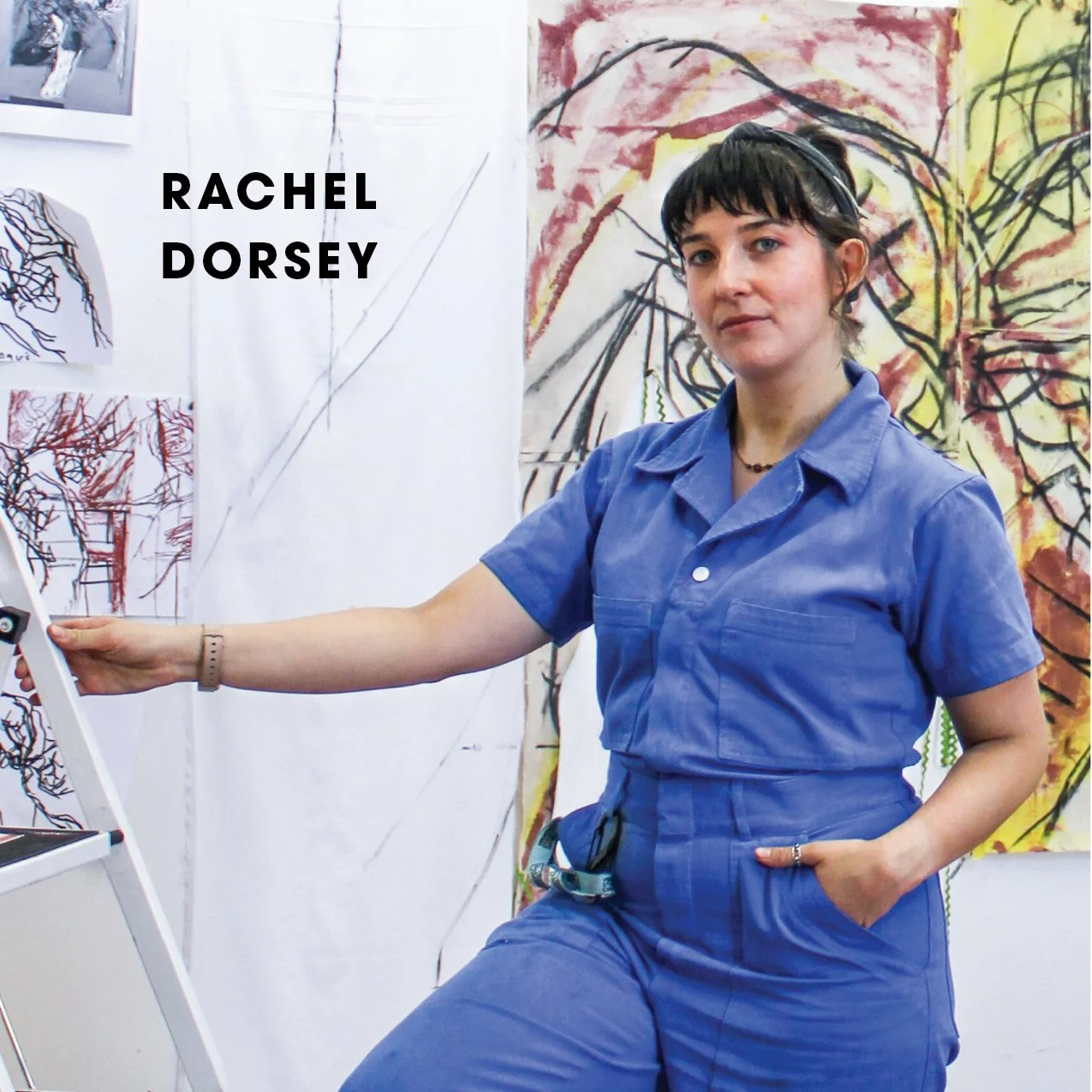
Artist Bio: Rachel Dorsey (b. 1992, Yonkers, NY) is an itinerant painter and multidisciplinary artist with ties to Seattle, WA, Northern California, Western Mass, and New York. Dorsey’s work explores care, grief, chronic illness, and family histories through large-scale figurative drawings, paintings, and prints.
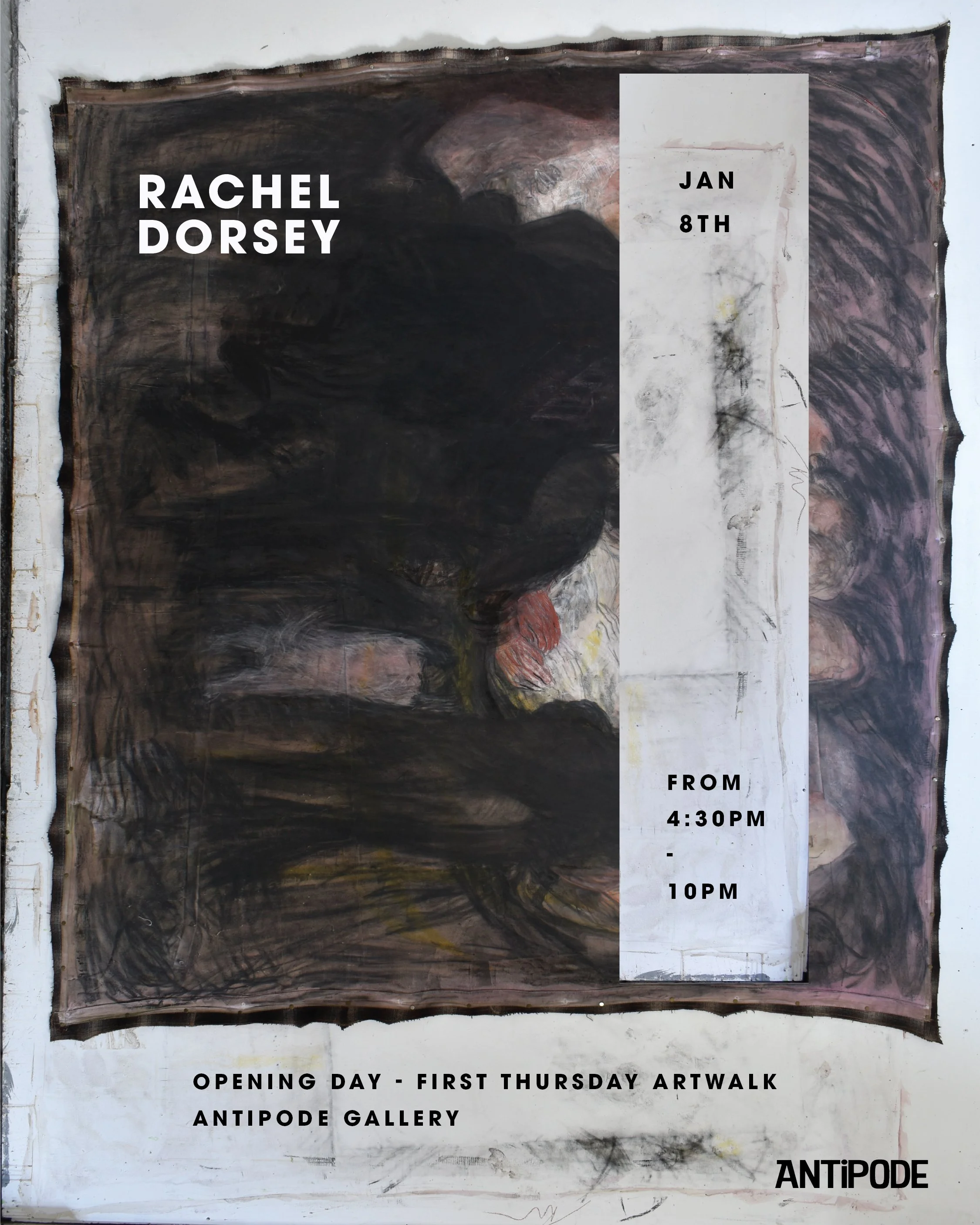
Careworn | A body of work dedicated to tight-knit, scrappy, dysfunctional families (biological and chosen).
Like families, words carry histories. Care’s direct linguistic ancestors connote grief, anxiety, lamentation, and sorrow; its Proto-Indo-European root gar means to cry out or call. In Gaeilge, my family’s would-be native tongue, gar- branches into gairm, gaire, gaoil, and gáire (calling, nearness, kinship, and laughter). This exhibition commemorates such acts. Expressed in large, gestural drawings, Careworn aims to explore infancy, injury, illness, aging, and death.
These drawings consist of charcoal, conte crayon, natural dyes, and oil stick on mended, patchworked fabric. Cloth for this project made its way to me from family members' closets, woolen mill scrap heaps and seamstress' floors, the stapled woven handles of firewood bundles, and soiled discards from an arts organization’s housekeeper. We sourced wood and metal similarly, combing through neighborhood "free" boxes, abandoned log piles, construction sites, salvage yards, and rummage shops.
Secondhand things become vocal collaborators. Wear patterns determine how marks and remnants come together. Dye material includes locally foraged rosemary and eucalyptus as well as kitchen table materials like black beans, turmeric, and black tea. Most of these dyes are not lightfast and, like memories, they shift and change over time.
Throughout the process, I felt like the editor of an anthology, pulling together a tapestry of short stories responding to a question: how, in big and small ways, do we care for one another? Western life frames care as either a burden or a privilege. How could we possibly be asked to tend to one more thing? On the other hand, connection pools and grows our resources. Can we afford not to care?
Mishaps shaped this work. Pieces bloated, sagged, and collapsed. When we show up, we often do so imperfectly. What does care look like when things fall apart? I turn to fellow members of our creative vermicompost: ancestors, neighbors, artist friends, mending and quilting traditions, and luminaries including disability justice activist Alice Wong. Among them, the voice of Gwendolyn Brooks rings in my ears, “we are each other’s harvest: we are each other’s business: we are each other’s magnitude and bond.” Careworn sits with her call.