
Saina Heshmati is a Seattle-based visual artist and curator whose practice centers on drawing, photography, and graphic design. Born and raised in Tehran, she spent the first 23 years of her life immersed in Tehran. In 2010, she moved to France to study Fine Art at the École des Beaux-Arts in Rennes. Since relocating to Seattle in 2013, Saina has continued to explore themes of identity, memory, and cultural transformation through her art.
Heshmati’s work often delves into the cultural limitations she experienced growing up, using art as a medium to revisit and reinterpret her past. In addition to her personal practice, Saina is the co-founded/curator ANTiPODE, a Seattle-based art initiative aimed at bridging cultural gaps and discussing the immigrant experience through group and solo exhibitions across painting, drawing, sculpture, film, dance poetry, sound, and installation.
The Seeker [the Search] and the Sought | A dance of transformation performed by process, outcome, stillness and motion.
As an artist I see a dance of freedom in this poem:
“They gazed upon the face of the Simurgh and found nothing but themselves. When they looked at themselves, they saw the Simurgh. There was no difference between the seeker and the sought.” — Farid al-Din Attar, The Conference of the Birds.
I have a habit of buying flowers, especially when I am sad. I watch them closely—not only when they are in full bloom, but throughout the brief span of their lives. Hungry for light, they turn. Thirsty for water, they bow. Restored, they slowly straighten again. Eventually, they dry, lose their color, and collapse. There is something in this performance of temporary beauty that feels like a dance to me—a dance toward freedom, a dance not unlike our own: we turn toward the light, we fall, we rise, and we begin anew, as if every stage were necessary for the next to emerge.
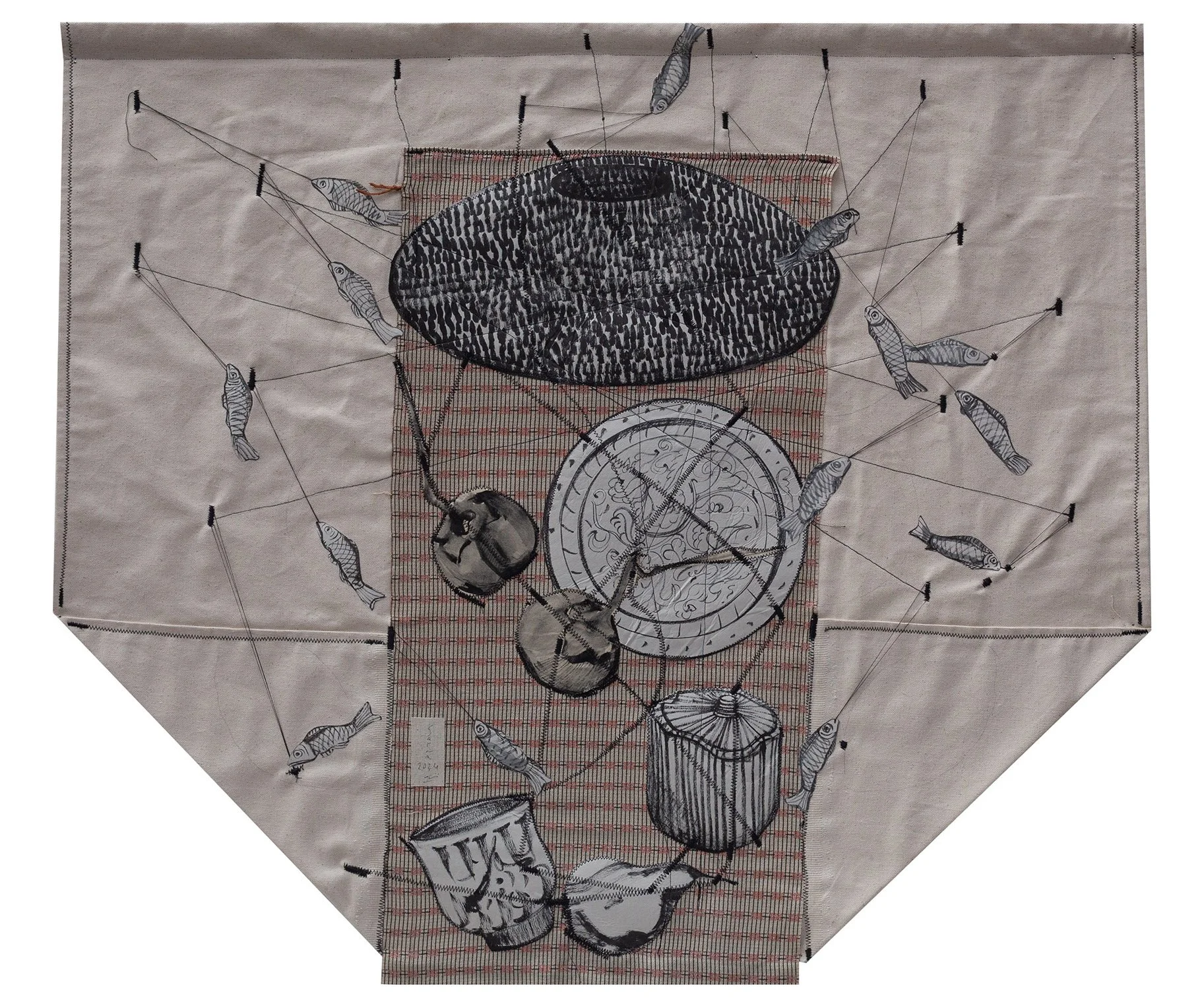
The Seeker [the Search] and the Sought approaches the artwork in a similar way: An arrangement of flowers and everyday objects becomes a still life. The still life becomes a drawing. The drawing alters the space around it. The process is preserved through layered images and torn pieces stitched to fabric. The drawings, collaged fragments, and torn pieces of paper then move from the wall onto a body. A still artwork becomes a garment, and the garment comes to life through choreography and dance. When the dance ends, the garment returns to the wall. What was once in motion becomes still again. The only difference is that this still object now carries within it the memory of the body that once moved in it.
Some of the arrangements are intentionally constructed, while others begin with an accident: a piece of fabric that has fallen onto cardboard, a drawing temporarily placed on a chair, or a piece of tape holding something in place. I have become interested in these unintended compositions because they capture something that a final, resolved artwork sometimes cannot: the moment when the work is still in the process of becoming.
What matters in The Seeker [the Search] and the Sought is not simply arriving at a final object; preserving the path that leads to its formation is an essential part of the work itself. In this dance of transformation, stillness and movement continually give way to one another. Bodies move and disappear. Drawings are fragmented and reconstructed. Installations take shape briefly, then transform into photographs or fabric. Each stage carries something of the one before it, while becoming the material for what comes next.
Through this process, the exhibition arrives at freedom not as a fixed state or final destination, but as something that emerges through transformation itself. On soil where process and result are understood as one, flowers of freedom can grow. And If I watch my flowers carefully, it leads me to a realization: when the seeker and the sought become inseparable, there is no such thing as a mistake. Every line, tear, fold, shadow, stitch, accident, and movement becomes a trace of time—a necessary part of the work's becoming.
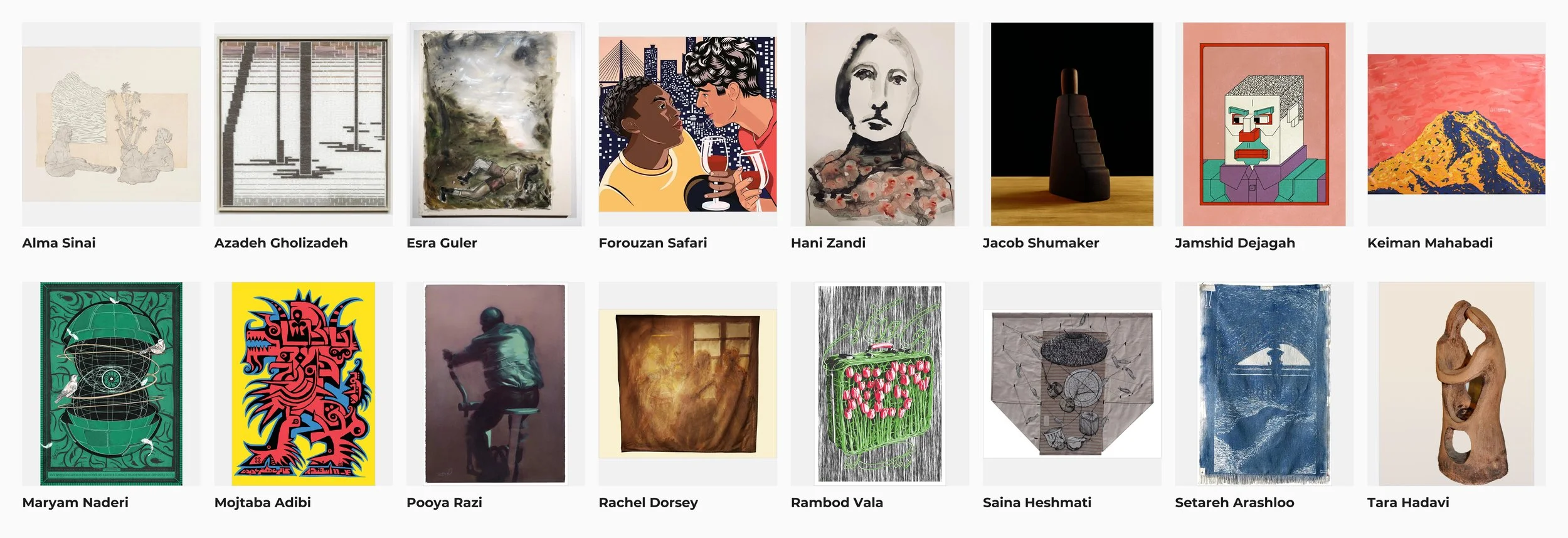
Artists: Alma Sinai, Azadeh Gholizadeh, Esra Guler, Forouzan Safari, Hani Zandi, Jacob Shumaker, Jamshid Dejagah, Keiman Mahabadi, Maryam Naderi, Mojtaba Adibi, Pooya Razi, Rachel Dorsey, Rambod Vala, Saina Heshmati, Setareh Arashloo, Tara Hadavi