

Artist Bio: Esra is an artist from Istanbul, Turkey. She lives in Seattle, WA. Esra's paintings focus on female self-expression and transformations. Her canvases feature improvised characters who grapple with grief and restrictions imposed by one’s memories, lineage, psyche, and culture. She had her debut solo show, No Worries, at The Kitchen Gallery at Museum of Museums (MoM), Seattle, WA, curated by Timothy Rysdyke. Her selected group exhibitions include I Want Your Skull, The Trophy Room LA, Los Angeles, curated by Matthew Gardocki; Soft Touch, and Factory Forever at Museum of Museums (MoM) curated by Timothy Rysdyke, and To Die For at Stephen Gilbert’s Studio, Seattle, WA, curated by Jeremy Buben. Dancing on Your Own Grave marks her first solo show at ANTiPODE, Seattle.
Esra holds an MFA from Bennington College, with a major in Writing/Fiction (2026), and a BFA from Cornish College of the Arts, with a major in Acting and minor in Playwriting (2009).
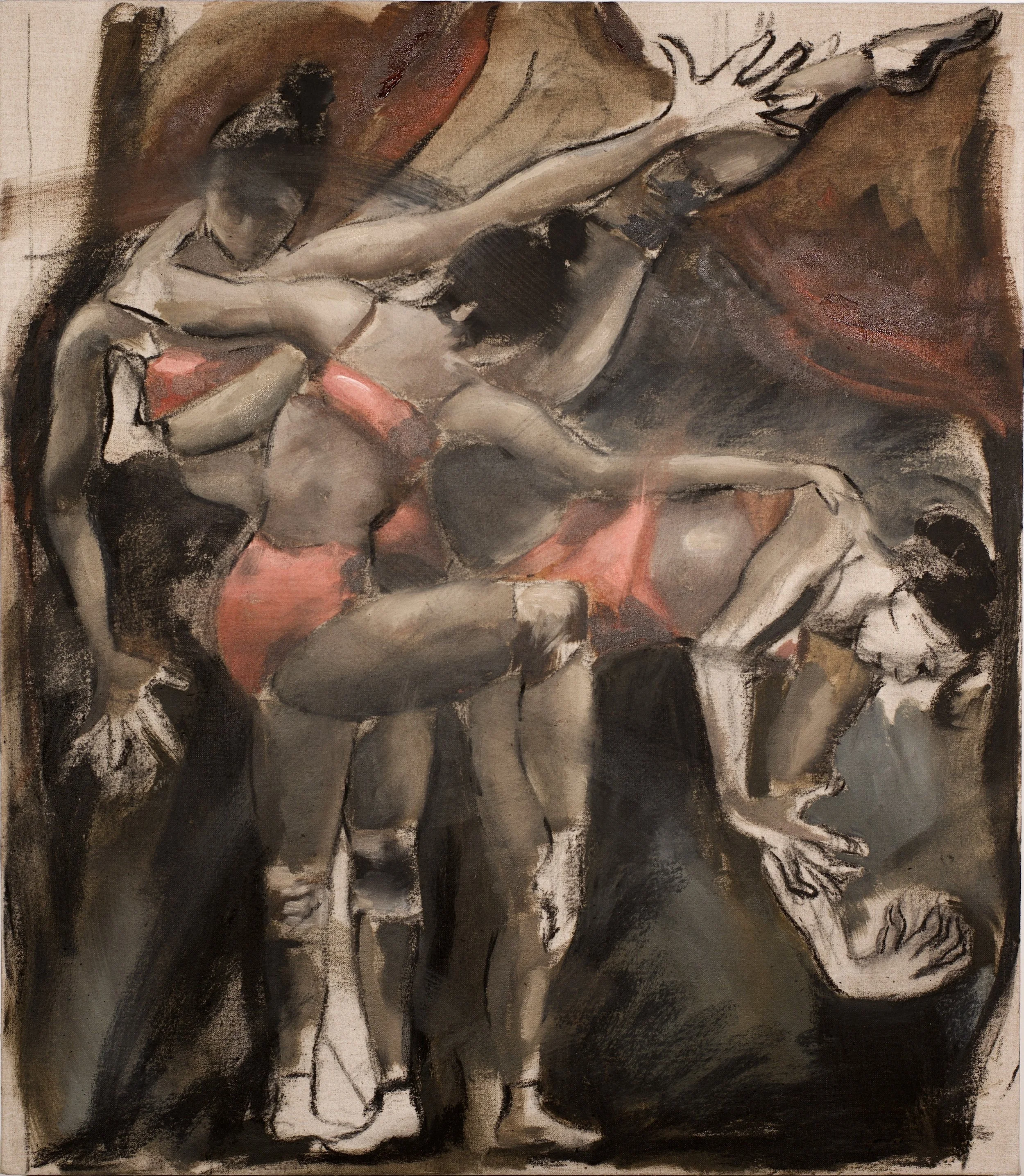
Dancing on Your Own Grave | An Experiment of Revolt, Rupture, and Play
I wanted to explore dance, performance, and drama as a frame for examining psyches grappling with violence. What is the aftermath of a violent attack, of cruelty? What is the motif behind the compulsive churning of narratives in our heads? To be enslaved by obsessive thought patterns? Is there a point to our inner reenactments? Do they generate new life? Help us evolve?
For over ten years, I created oil paintings in the most traditional sense, with a dedication to conventional materials and applications. I often worked in layers to make flesh look like flesh and to make objects seem convincing. Yet rather than being liberated by what I tried to master, I felt its grip on my hand, brush, and the breadth of my thoughts. My figures, in turn, acted with reservation.
This body of work is the result of a three-year exploration when I discarded oil paints for a long while and worked with charcoal and extremely wet acrylics, which I had no mastery over. Each painting was done in a rush, like a sketch before the paint dried, which allowed me no time for obsessive judgment. As I moved the charcoal stick on the canvas to find the limbs of the figures, the questions of “Are you there?” and “What do you have to say?” echoed in my mind. Working this way, the process and the content became improvisational, unpredictable, and full of discoveries. It felt as if tradition had been a restrictive piece of clothing, and I had to yank it from my body to start swimming naked.
As my approach to painting evolved, the figures seemed to enter into that messy, brutal, and at times soft relationship with control and constraint in a new way. By permitting their clownish acts, entanglements, and stillness, regardless of how dramatic or cheesy they appeared, new narratives unfolded, and soon, a “show” within a show began to emerge. The canvas became a theater, a game, a place to cultivate a new mastery. And hopefully, a place to depict grace in human struggle to understand what does not always make sense.