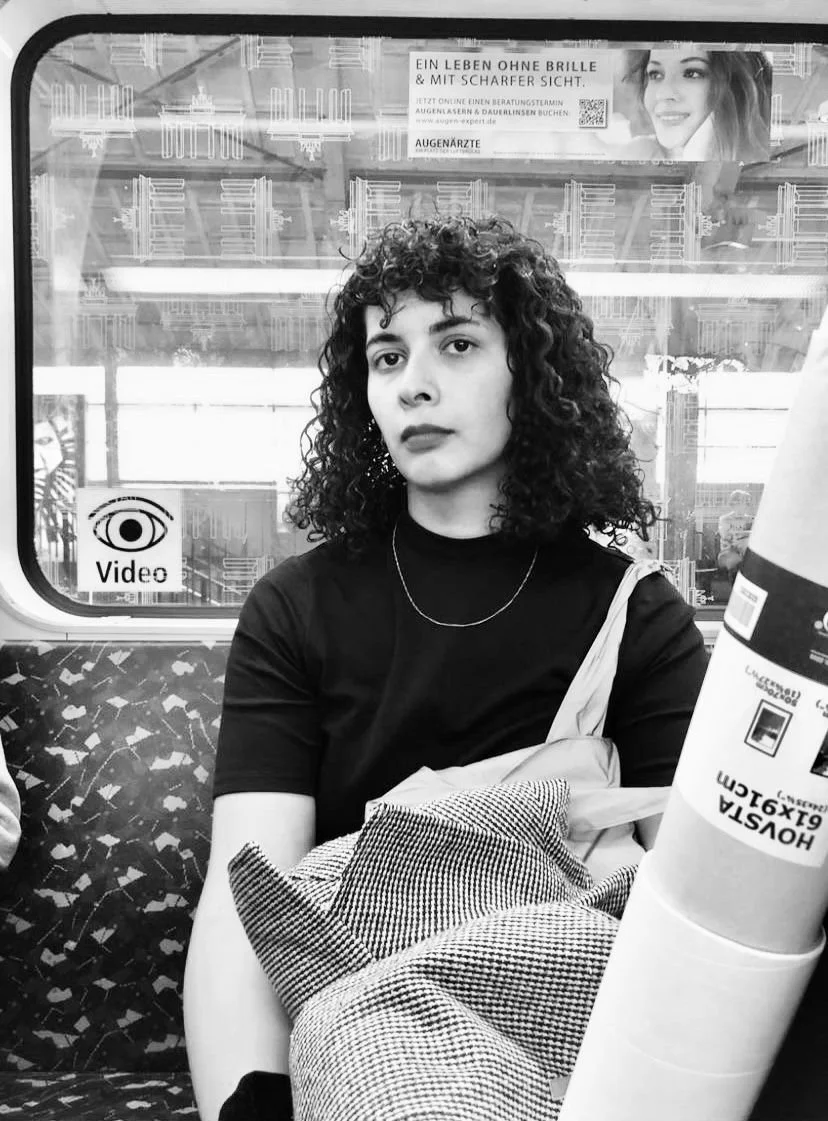
Artist Bio: Forouzan Safari is an Iranian artist from Isfahan based in Los Angeles, California. She studied Fine Art Painting at Otis College of Art and Design and received her MFA in Animation from the UCLA School of Theater, Film and Television.
Her work is shaped by personal experience, memory, and migration, often exploring themes of identity, gender, and freedom. Working across drawing, digital media, animation, and image-making, she creates narratives rooted in everyday life and influenced by Iranian visual culture and diaspora experiences.
Through her practice, she reimagines spaces, bodies, and histories that have been censored, displaced, or left unseen.
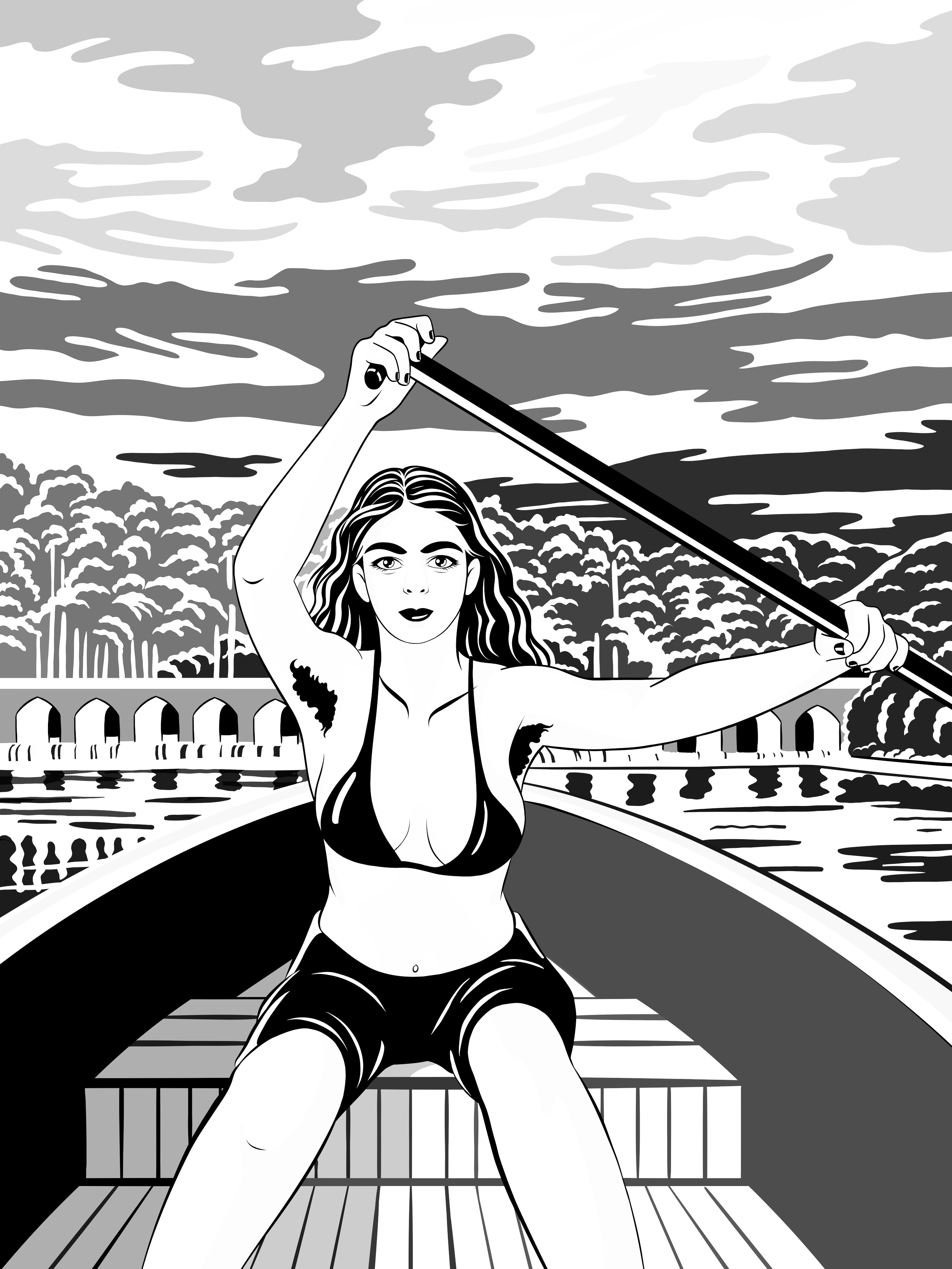
Imagined Freedom | Revealing Bodies Never Allowed to Be Seen
Bodies are not merely subjects of representation. They carry memory, distance, desire, censorship, and imagination.
Drawing bodies began in childhood. The fashion illustrations in my mother’s sewing magazines. Then she immigrated. To the United States. Years of living with grandparents. Then public life in Iran. As a woman. From the safety of home into a tight space shaped by discrimination, restriction, and control. Then I immigrated. From the known history of Isfahan to unknown highways of LA. From home to a suspended space between memory and reality. To study painting.
Drawing bodies began in childhood. An interest first. Then it became a way through things. Years of growing up away from my mother. Distance. Loneliness. What it could not put into words. Then it became a way of preserving. Memories. Home. Not only as a place but as a collection of images and people left behind. Living. In my head. Images of streets, family gatherings, women, music, and the things that always had to remain hidden.
Then I began painting. Dreams started to form. Dreams instead of memories. Ideas began arriving faster. Painting could no longer keep up. Digital drawing became the primary medium. The pace of creation increased. Images multiplied. No longer of the home I had left behind, but of a free life that could have existed there: women walking freely in the streets, bodies no longer hidden, an ancient boat finally moving, a young generation no longer grounded between hope and freedom.
Then the “Woman, Life, Freedom” movement in 2022. A timeless fight. Needed everywhere, in different forms. The younger generation back home turned parts of my dreams into reality. Their authentic struggle for freedom, identity, and belonging gave life to bodies I had always been drawn to draw. They moved the boat I was on.
Then I moved deeper into my immigrant identity. I began to understand first- and second-generation Iranians in the United States. People whose connection to Iran is shaped through inherited memories, family narratives, and imagination. For many of them, Iran exists as both something familiar and something imagined.
This body of work is cooked at multiple homes: the one I left behind, the one I wish had existed, the one shaped by “Woman, Life, Freedom,” and the one formed through inherited memory, family narratives, and orientalist imagery.
Influenced by popular culture and the language of cinema, these drawings represent an alternative reality. One not defined by the 1979 Revolution. One shaped by bodies. Women’s and queer bodies. Bodies freely inhabiting public and historical spaces. Bodies performing activities that may be considered ordinary elsewhere, but for which people in Iran risk disappearance or death.
About VOICE: VOICE (Visual Outputs for Inclusive Change and Environments) is a nonprofit organization advocating for social justice in conflict-affected areas. VOICE employs architecture and design to implement recorded observations of people and societal actions during extreme emotional and traumatic events. For more information about VOICE please visit this .
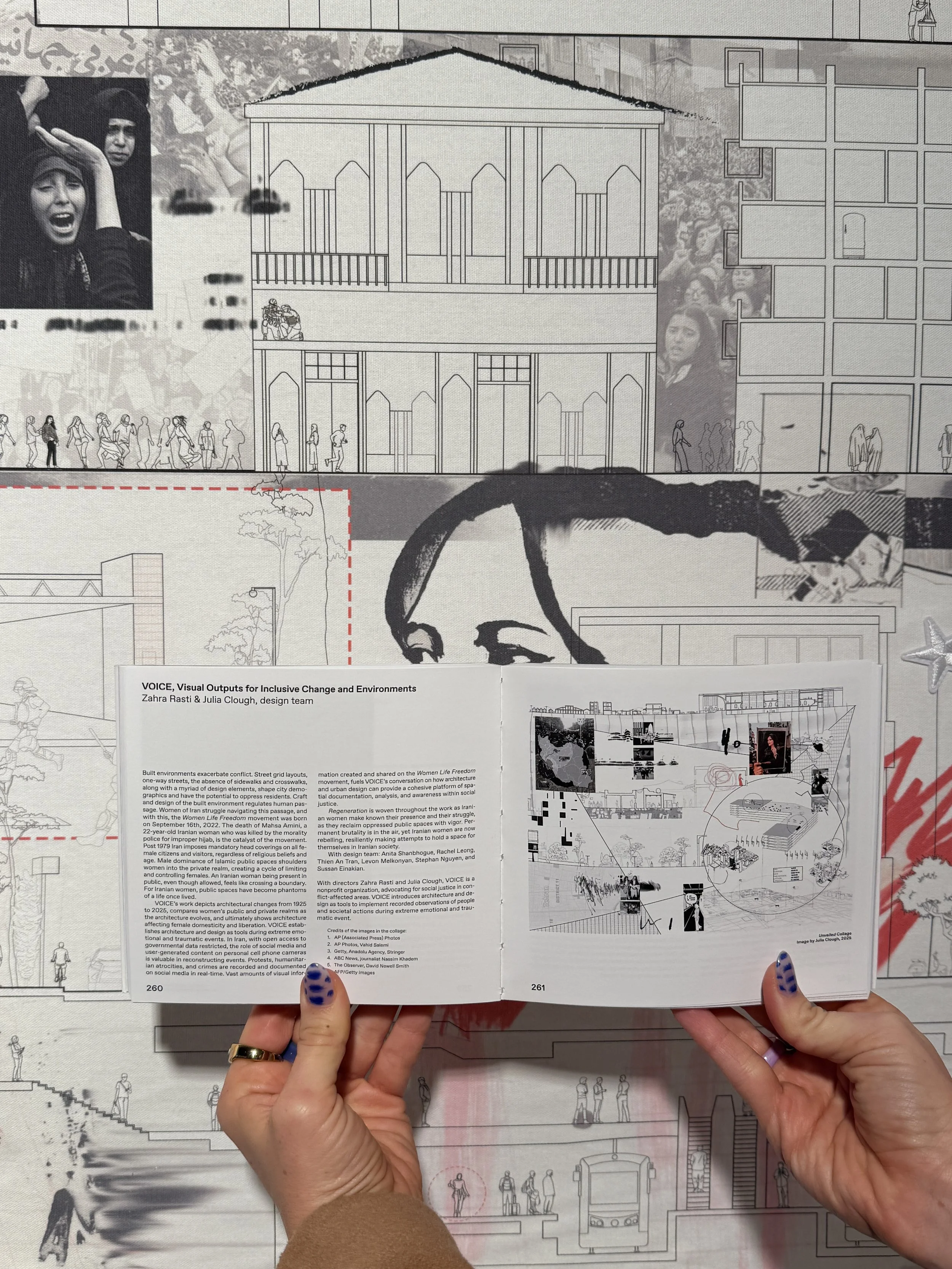
Politics of Visibility | Visualizing Resistance through Space and Identity
A Two-Column Installation By VOICE
Mapping for Social Justice translates user-generated digital content (videos, images, and social media coverage of protests) into spatial knowledge. It examines how events unfold within the built environment and asks whether spatial approaches to documenting and visualizing protests can support lawyers, artists, and social activists in their processes of fact-finding, analysis, and advocacy. Central to this work is the role of public space as a site where power, resistance, and collective voice become visible.
Building on this framework, the work presents a series of drawings and mappings developed through the Women, Life, Freedom movement. These works examine how protests occupy, transform, and are documented within the built environment. Through mapping, 3D modeling, and image analysis, fragmented visual data is reconstructed into spatial and temporal narratives, revealing how authority operates within public space, and how acts of resistance challenge and reconfigure it. Here, drawing becomes both an analytical method and a form of evidence, capturing the tension between control and expression in the urban realm.
Passports of Identity presents paired passport images from Iranian women across two conditions: one taken under enforced regulations, and the other after obtaining new citizenship, where self-representation becomes possible. These images expose how authority inscribes itself onto both space and the body (operating through architecture in one instance, and through documentation in another) while also highlighting moments of agency, resistance, and self-definition.
Together, these two columns frame a continuum from public space to public document, revealing how structures of power shape both collective environments and individual identities, and how visual practices can challenge, document, and reframe these conditions.