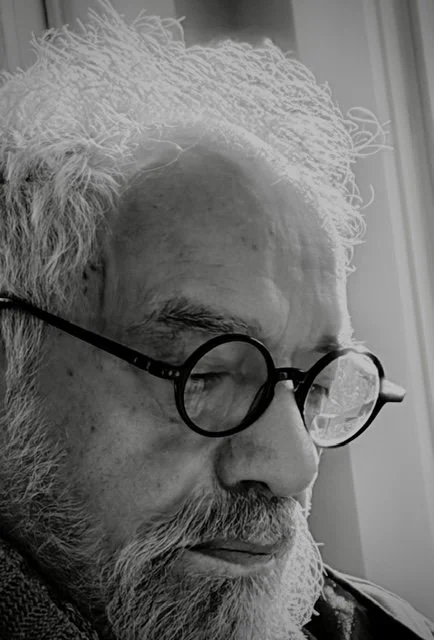
Photo by Joseph Zarba
Nikzad “Nicky” Nodjoumi (b. 1942, Kermanshah, Iran) is one of the most important Iranian-born artists of his generation. His achievements began early: in his twenties, his illustrations for a Kanoon children’s book were honored at the Bologna Children’s Book Fair, and before he was forty, after studies at Tehran University and the City College of New York, he was given a retrospective at the Tehran Museum of Contemporary Art. That exhibition changed his life forever and forced him to leave Iran. What happened, and what became of the more than a hundred works he left behind, is the subject of A Revolution on Canvas (2023), the HBO documentary by Sara Nodjoumi and Till Schauder, which premiered at Tribeca.
Rebuilding his career in New York took years and a stack of rejection letters. After early solo shows at the Alternative Museum (1983) and Artists Space, he gradually found his footing in New York’s gallery scene, from Leila Heller to Stefan Stux to Pierogy. His work also began attracting critical attention, including reviews by Holland Cotter in The New York Times and in Art in America and ARTnews. Museums and biennials followed: Iran Inside Out at the Chelsea Art Museum and the 10th Havana Biennial (both 2009), Asia Society’s Iran Modern (2013), the largest exhibition of modern Iranian art ever held outside Iran, and the 58th Carnegie International (2022). Solo exhibitions have since taken him from Yerba Buena Center for the Arts in San Francisco and the Cleveland Institute of Art to Taymour Grahne in London and Barakat Contemporary in Seoul.
Nicky’s work is in the collections of the Metropolitan Museum of Art, the British Museum, LACMA, the Guggenheim Abu Dhabi, the Nelson-Atkins Museum of Art, the National Museum of Fine Arts of Cuba, and the Smithsonian’s National Museum of Asian Art, which acquired his monumental three-panel ink work Here is Aleppo (2017). Now in his eighties, Nicky is still at work, painting and drawing in his studio in Greenpoint, Brooklyn.
فُرم است و فُرم است و فُرم | Drawings by Nicky Nodjoumi
Opening Ceremony including Live Jazz Performance: Thursday Dec 3rd 2026 5pm-9pm
On view until Mid February
ANTiPODE wants to paint the immigrant experience: images of the old homes we leave behind and the ways they continue to shape us; images of the new homes we build while longing to belong; and images of the bridges we carry within ourselves. Bridges between homes, made of guilt and hope. We don't want to leave you with a fleeting sense of guilt or awareness. We dream of leaving a lasting, relatable, and powerful mark.
To leave such a mark is no easy task. The immigrant experience is reluctantly political, and making political art comes with its own dangers. Politics—today more than ever—moves in short-lived waves. A headline breaks, a feed fills, outrage peaks, and a week later something else has taken its place. Half of our story, if not more, unfolds far from here. And in trying to make that story relatable to you, we risk becoming objectified by Western expectations that so often demand one-sided narratives of victimhood. We are so much more than victims. We've come a long way, and the journey has made us strong.
To respond to such a dilemma, we poetically believe in the power of form: forms that capture the immediacy of emotions; forms that distill time-bound issues into their essences; and forms that tell stories of our suffering from a position of power. Such forms cannot be generated overnight (certainly not by today's biggest thief: AI). It takes a lifetime of dedication by a master to sculpt sensitive and political material into potent archetypes.
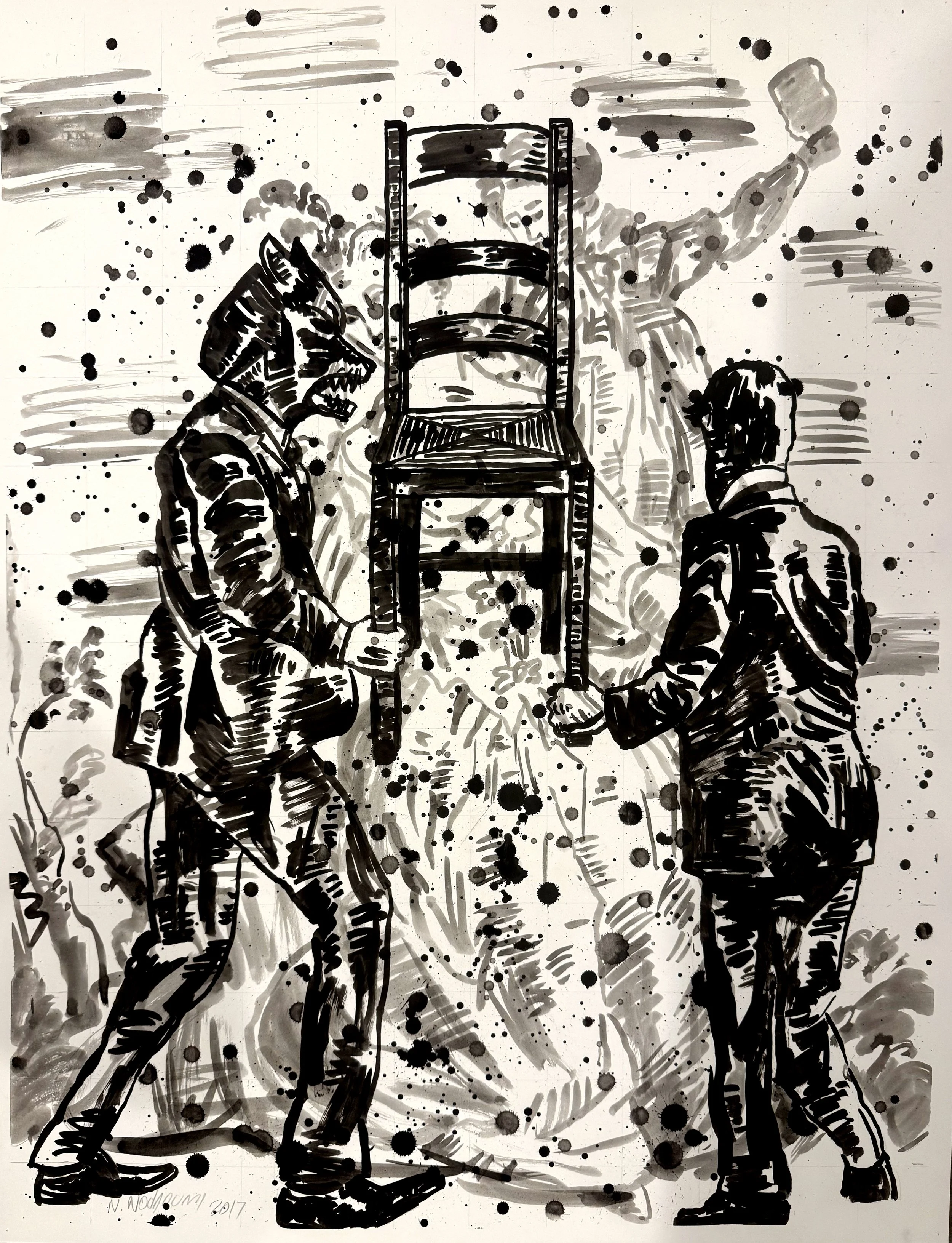
Nicky Nodjoumi is both the proof and the north star of this claim. Take his chair, for example. In the mid-1970s, in Tehran, Nicky was interrogated by the Shah's secret police for three months. He distilled that personal experience into one plain object: a chair, which has returned to his work ever since. The chair carries no date and no flag. Anyone who has waited to be questioned—at a border, in a jail in Tehran, in a stadium in Santiago, or across a desk at work or school—knows what it means to be told to sit.
Over six decades and across continents, Nicky has presented timeless and universal bodies of work. In his twenties, his illustrations for Farideh Farjam's The Crystal Flower and the Sun were honored at the Bologna Children's Book Fair; before he was forty, the Tehran Museum of Contemporary Art gave him a retrospective. In exile in New York, he rebuilt his career from textile jobs and gallery rejections into a body of work now held by the Metropolitan Museum of Art, the British Museum, LACMA, the Guggenheim Abu Dhabi, the Nelson-Atkins Museum of Art, and the Smithsonian, and, somewhere in its storage, by the Tehran Museum of Contemporary Art.
Nicky starts with the most temporary material there is: the morning paper. He cuts out heads and gestures, re-stages them on an empty ground, and lets them settle into archetypes: the man in a suit, the cleric, the clown, the horse, the ape, the rabbit-headed man, the courtier borrowed from a Persian miniature. They are no longer anyone in particular, and so they can be anyone. "The paintings are generally about people in power; it doesn't matter what country," he says.
A revolutionary his entire life, Nicky has many reasons to paint a victim. He paints the powerful instead. He flips the table. The man who was once told to sit now arranges the room: he casts the men in suits as actors on his bare stage, cuts them apart, gives one a fox’s head, and lets them be absurd, "funny in a bitter way." He does not ask for pity, and he does not offer it. He holds up a mirror and lets power see how ridiculous it looks. His immigration, in his words, was forced; his art has never been forced into anything.
Nicky is, by any measure, much bigger than our gallery. He is the north star of our mission: proof that art can transform temporary political events and personal suffering into lasting, universal forms that make us feel, in a world where escaping lasting emotions is considered efficient. But don't take our word for it. Stand in front of any drawing in this gallery and feel for yourself. You don't need the backstory to feel what he wants you to feel.